Straightforward sangria and crispy patatas bravas
August 5, 2009 § 2 Comments
As promised, two of the many recipes from tapas at Phil’s.

Sangria
1/2 cup sugar syrup (half part sugar, half part water, heated until sugar dissolves)
two bottles of fruit red wine or red Zinfandel (we used one of each and doubled the recipe)
juice of 2 lemons
2 oranges, sliced
2 lemons, sliced
2 apples, sliced
2 peaches, sliced
1 large bottle of sparkling water
Combine all ingredients in a pitcher or large punch bowl and refrigerate for at least 2 hours, preferably overnight. Serve with ice.

Patatas bravas
These are a classic tapas dish in Spain, and as with anything involving potatoes and extra virgin olive oil, they are so delicious without the heaviness of something deep-fried. Really easy to make too. They’re traditionally served with a spicy tomato sauce and/or allioli, the garlic mayonnaise.
16 small red potatoes, quartered. Leave skins on.
1/2 cup extra virgin olive oil, or enough to coat all the potatoes
coarse salt
Preheat the oven to 425 degrees. Put the potatoes in large pot and cover by 2 inches of water. Bring to a boil, and then turn heat to medium. Leave for about 20 minutes, until potatoes are fork tender.
Transfer potatoes to a baking sheet, toss with the olive oil and salt, and spread into one even layer. Bake for about 45 minutes, or until golden brown. Serve with tomato sauce.
Tomato Sauce
2 cups plain marinara sauce
cumin, cayenne pepper, paprika to taste
Combine to personal taste and heat.
Tapas party at Phil’s
August 3, 2009 § Leave a comment
My friend Phil recently got his entire kitchen renovated (it’s soooo beautiful!) so a bunch of us invited ourselves over there to cook up some Spanish tapas dishes. Needless to say, after three hardworking, sweaty hours, and two rounds of delicious food (and before we were even able to get to the churros and Spanish hot chocolate), we were gut-bustingly full on gambas al ajillo (shrimp with garlic), patatas bravas (crispy, peasant-style potatoes dipped in tomato sauce), and other dishes. And I just wanted to thank everyone for putting up with me barking orders at them, especially Phil, who had his kitchen taken over by a food-obsessed mad woman and his parents who trusted that we wouldn’t destroy their house, and Julia, who took all the pictures while I was running around the kitchen.
Menu
- Spicy and candied almonds
- Gambas al ajillo, shrimp with garlic
- Sauteed wild and cultivated mushrooms with parsley
- Patatas bravas, peasant style potatoes
- Pan con tomate, bread with tomato rub
- Espinacas a la catalana (Spinach Catalan-style)
- Steak au poivre (which, yes, is French and really had no business being there but we needed beef)
- Sangria
The shrimp, potatoes, and steak (no surprise with this meat and taters loving group) were the biggest hits of the night but what made me happiest was everyone seemed to be eating everything. Even the spinach wasn’t neglected.
Ddukbokgi, Korean-style gnocchi
June 30, 2009 § 2 Comments
A lot of people call dduki Korean rice cakes, but that name always conjures up images of the Quaker oats man and flavorless pieces of cardboard. I think these dduk can be more likened to gnocchi, but instead of potatoes and flour, these dumplings are made of rice flour and water.
One of the most popular dishes to feature these starchy bites is ddukbokgi which I tried for the first time at Mandu in Dupont Circle, DC. After some recipe browsing online, I realized that I’d never be able to recreate the dish authentically unless I had the Korean hot pepper paste, dochujang, and since I had never tried anything else with that same sauce, I thought I’d never have the opportunity.
However, thanks to my mom and her grocery shopping impulses, the last time I was home during spring break, she brought home a HUGE tub of the stuff that only cost $7 without even really knowing what it was good for. When I saw it after coming back from Hong Kong, on my first trip to Kam Man supermarket, I made a beeline for the cylindrical dduk (you can use ovalettes in this recipe too but I prefer the meatier cylinders) and cooked the dish the same day. Paired with Korean-style bbq short ribs, this makes a really delicious and satisfying meal.
Unlike the version at Mandu, I add red bell peppers, which accented the sweetness of the sauce and added the necessary crunch to contrast with the soft and squishy dduk. Yum. Just a note: if you’re heating leftovers the next day, it’s better to heat them on the stove rather than the microwave. That way they soften up again.

Separate the dduk. If you think the cylinders are too big, you can cut each of them in half, but I like them to be quite substantial bites. Drop the dduk in a large pot of boiling water, making sure you salt the water first. Drain after cooked all the way through and soft; this usually takes about 5 minutes.
In a bowl, mix together the soy sauce, dochujang, sugar, sesame oil, and garlic. It should taken on the consistency of ketchup.
In a wok or large saute pan on medium heat, add oil. When hot, add vegetables and stirfry for 3-4 minutes until cooked. Add the drained dduk as well as the sauce mixture and stir until everything is evenly coated and heated through. Add salt to taste. For garnish, you can top the ddukbokgi with sliced scallions and toasted sesame seeds.
Gimme my galbi
April 8, 2009 § Leave a comment
This is the recipe for the Korean galbi that accompanied the dry-fried green beans in the previous post. Sometimes, you just need a good helping of beef with a little bit of green on the side. These short ribs marinated for about 10 hours in the fridge before I slapped them on the smoking hot grill pan, and the flavor was amazing. Good caramelized crust on the outside and wonderfully tender insides.
Kiwi may seem like a strange ingredient, but other people – who add apple or pear – do add fruit, probably because it acts as a great tenderizer for the beef. Ideally you would puree everything in the marinade, but I don’t have a food processor so I just diced everything and it turned out fine. Everyone loved it, and this is definitely a great thing to eat when you have guests around and want to prepare them. In my experience, Korean bbq is pretty expensive in restaurants, so this is also a good way to eat well and save some money in the comfort of your own home. Just make sure someone else is delegated to do the dishes.

Korean Galbi
1 tbspn black pepper
Wash any bits of bone from the ribs and then pat dry with paper towels. Mix/puree the ingredients for the marinade and pour into a pan. Add the ribs and marinate for 8-10 hours, the longer the better. Heat a grill pan until smoking hot and grill for 2-3 minutes. These are thinly cut so you really don’t need that much time to get a medium rare short rib. Eat.
Dragon Palace-style Green Beans
April 6, 2009 § Leave a comment
When I’m home for breaks, there is one restaurant that our family must always go to for dinner – Dragon Palace. It serves amazing Sichuan food that we can’t get anywhere else, and the fact that it’s about a three minute drive from our house is a plus. We always show up early before the dinner rush, our waiter is always the same, and we always order the same three or four dishes and then branch out a bit. Sometimes, familiarity can only be a good thing.
One of the must-order dishes is the Sichuan dry-fried green beans. Now, my mom is a pretty good cook, but her green bean dishes could never compared to the wonderfully blistered and salty nuances of Dragon Palace’s version. The beans are crisp but somehow still juicy on the inside, and that light smattering of ground pork is always a good thing. The last time I was home, I think they knew we were going to order it, and they gave us an extra huge helping.
Originally, I assumed that their version was superior simply because they were a restaurant; they had to make it better because otherwise no one would pay for it. But, while browsing the archives of one of my new-favorite blogs, appetiteforchina, I found a dish called “dry-fried green beans” and I knew that I might have found the answer to my string bean-pleas.
We didn’t have ground pork when I made this version, and I also added maybe too much chili paste. It was a lot spicier than I intended to turn out but it was still delicious. We paired the beans with some Korean galbi which I’ll post about later. Together, it was probably the fastest, simplest, most delicious meal that I cooked while I was home.
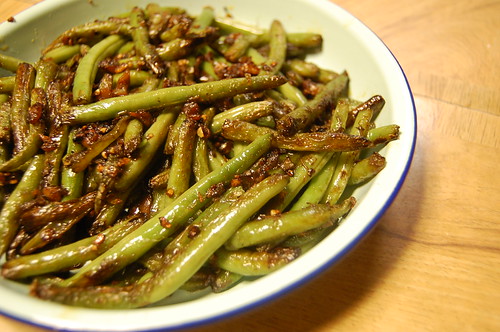
Dry-fried Green Beans a la Dragon Palace
lots and lots of canola oil (about 3-4 tablespoons)
Heat the oil in a wok until just beginning to smoke. Add green beans and stir fry. Again, make sure that the beans are really really dry, otherwise they’ll cause a lot of oil to splatter when you add them. These are delicious but they’re not worth any serious grease burns. Make sure the beans all get a coating of the oil and stir them constantly for about 8-10 minutes until they finally begin to blister. When the beans are wilted, take them out and drain on paper towels.
Remove all but 2 tablespoons of oil. Add garlic, ginger, preserved mustard, shrimp and cook for about 1 minute until fragrant. Return beans to the wok and add chili bean paste (you can add more if you like it really really spicy), sugar, salt, sesame oil and stir until well combined. Serve blazing hot.
Answer to laziness? Why, more carbs, of course.
March 17, 2009 § Leave a comment
Anyone who knows me moderately well can tell you about my obsession with anything [more like anyone] British. It’s the accent, the sarcastic humor, the cute names for everything [ex: jumbleberry crumble], that laidback poshness. Sadly, I’ve never actually been to England [though next spring break may change that], but I live vicariously through Nigella Lawson by watching her videos on Youtube.
Even though she’s known as a “domestic goddess,” I think she’s also one of the laziest and most clumsy cooks on television, though it makes me love her even more. Her dishes are sometimes so simple that you really don’t need a recipe, and there’s no fuss for which, as a poor college student who hates spending money on random ingredients, I am grateful.
Linguine with thyme mushrooms is such a dish. I think button mushrooms are probably one of the most versatile ingredients you can have. Throw them into pasta sauce for an extra meatiness or sautee them with the pan drippings of your steak to make them even more rich. There’s really nothing like a bunch of mushrooms to add more to your food. What makes this dish even better is butter. And lots of it. Sometimes, you just have to indulge. Or, if you’re Nigella, every meal is already an indulgence.

Linguine with Thyme Mushrooms (adapted from Nigella Lawson)
garnish: handful of chopped parsley and shaved Parmesan
Cook pasta according to instructions. Make sure you salt the water, and before you add the linguine, drizzle a bit of olive oil into the pot to prevent the pasta from sticking together. Retain some of the pasta water and loosely drain the linguine when al dente, with a little bite.
Snackin’ on Guac
March 16, 2009 § Leave a comment
Eating guacamole by myself at school is sometimes a waste; at our supermarket, it only comes in medium-sized tubs, so by the time I’ve had my fill, my guac has already turned an unappetizing brown color. Home, on the other hand, is a different story. When Laura and Jackie get back from school, I can put together a fresh guacamole in less then 10 minutes and it’s gone in 5.
In my opinion, guacamole is better when it’s simpler. This recipe is really basic, and I love it with some blue or lime salted tortilla chips.

Guacamole
Happy Lunar New Year!
January 26, 2009 § Leave a comment
I’m so homesick right now as I look through my photos of real roast duck, slow-cooked pork belly with mushrooms, and other delicious Chinese dishes from when I was off for winter break. Jia and I went to a Chinese restaurant called Harmony Cafe this past weekend but in my opinion, it really didn’t measure up to authentic Chinese cuisine. I wanted hot pot with spicy peanut sauce or pork or red bean buns and instead I ended up getting a flavorless ma po tofu and beef chow fun. DAMN YOU DC WHY DON’T YOU HAVE A HALF-DECENT CHINATOWN!? One can only have so many cupcakes in a given time before she starts to go insane.
Nevertheless, the room is now as clean as it will ever be in that rush to get rid of any lingering bad spirits, but I haven’t found anything red to hang up for good luck. I’m still contemplating what I’m going to have for dinner tonight, seeing how any Chinese food that I order will be sub-par, but maybe we’ll manage to find something edible?
When I was home our entire family chipped in to make these simple scallion and peanut butter pancakes. Since finding the recipe via userealbutter, I don’t think my parents have ever really felt the need to buy them at our local Asian supermarket. This was also the first time we tried using peanut butter with a light sprinkling of sugar, and OH EM GEE it was delicious. Next time I’m voting to try using red bean paste. I think red bean + anything pan fried = heaven. AAAAAAAAAAAAAh.
Just a note for this recipe: The measurements given are just a guesstimate. I found that there was not enough water, so I had to add a little extra to get the right consistency. Just trust your instinct until you can feel with your fingers the texture that you’re looking for and then you’ll be fine. You’re going to dust your board with a lot of flour as well so even if it is a bit sticky at first, it won’t be for long.

salt
In a large bowl, mix the flour gradually with the 1/4 cup of water until the water is completely absorbed. Continue adding water in small increments and mix thoroughly until the dough begins to pull away from the side of the bowl. Let it rest for about 20 minutes and cover with a damp towel.
Cut the dough into about 6 pieces of equal size and roll them into balls. Place dough onto a well-floured work surface and roll out into a thin circle about 1/16 inch thick. Spread teaspoon of oil evenly over the pancake. [I find that it’s easiest to just use your hands to do the spreading, even if it is a bit messy. The oil is more uniform that way and it’s much quicker.] Sprinkle salt evenly and then curl the roll into a spiral from top to flatten it. Roll the pancake out to 1/8th inch thickness.
A simple shrimp scampi
January 16, 2009 § 1 Comment
It’s freezing in DC; -4 degrees with the windchill, and everytime I go outside I think my fingers and toes are going to freeze and snap right off. I really hope Inauguration Day isn’t this bad, because then I’m gonna have to wear about 1293102938 layers while waiting out in the cold. Oh…did I not tell you that I would be going? Well, I don’t have tickets, but I will be going with friends to the National Mall, at least to tell my children that I was there that day.
Anyway, the cold makes me want to eat food even more because with cooking comes warmth, and I always think of Ina Garten’s recipe for shrimp scampi. There’s your protein from the shrimp, fruit from the lemons, veggies from the parsley (yes parsley’s an herb but it’s green so I count it as veg), and lots of yummy carbs and fats from the pasta and butter! And it really doesn’t take too much time to make. After learning how to make this, I never order this dish in restaurants anymore. It’s just a waste of money and meal on my part!

Instructions:
Drizzle some oil in a large pot of boiling salted water, add 1 tablespoon of salt and the linguine, and cook for 7 to 10 minutes, or according to the directions on the package.
In a large heavy bottomed pan, melt the butter and olive oil over medium low heat. Add the garlic and saute for one minute. Be careful since the garlic burns easily. Add the shrimp, 1 1/2 teaspoons of salt, and the black pepper. Saute until the shrimp have just turned pink, about 5 minutes, stirring often. Remove from the heat, add the parsley, lemon zest, lemon juice, lemon slices, and red pepper flakes. Toss to combine.
Making gnocchi
January 3, 2009 § Leave a comment
At school, one of my favorite things to eat is potato gnocchi from Dean and Deluca. I always thought that making pasta is a complicated process, but after watching a random youtube video, I decided to try it when my sisters were at home and helping.


 Notes on Food